Did Our Ancestors Celebrate the Autumnal Equinox?
 Yes, it’s that time of year: approaching the Autumnal Equinox. The world has gone into pumpkin spice everything, the weather has been shifting towards colder, and darkness is creeping up on us. Living in the Northern Rockies, I started noticing the shift in weather in August, and darkness has crept up on us. When we had light at almost 11 pm, we now have total darkness before 9 pm.
 Even at less extreme latitudes, people probably notice the march toward the darker days. So one has to wonder if our northern ancestors celebrated the equinox.
The Equinox was a Time of Harvest
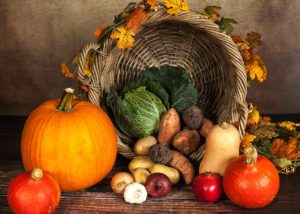 The Norse split the seasons into two: winter and summer. It makes sense, really, because there was just growing seasons and snow. As much as I’d like to think our ancestors marked the equinox, chances are they were too busy getting the harvest put up.
Right now, my own experience as a landholder tells me that people probably were concerned about getting prepared for winter. For my family, it is getting enough hay and firewood for the winter. The upcoming winter requires me to dry fruits and vegetables for use during the winter months and get them stored properly, because there are times I won’t be able to get to the grocery store.
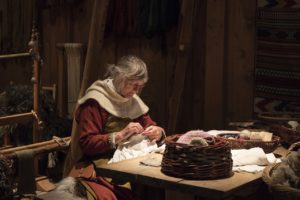 For our ancestors, their experience was much more dire. They were their own store, meaning that if they didn’t have it, or if their family didn’t have it, they went without. Sure, they could (and did) hunt, fish, and slaughter their own animals, but if they didn’t have enough of a certain food, they went without.
In this day of local grocery markets, it kind of blows one’s mind to think if you didn’t have enough of something, that was too bad. That meant that harvest was exceedingly important because if it didn’t produce enough, you were screwed.
This is why our ancestors put so much emphasis into the seasons. The seasons governed their lives and dictated when they had to do certain things to survive.
Community was Important
 Back then, community wasn’t just for socialization. It was the only means you could survive in that harsh climate. You did a lot of things, but there were other people whose expertise you relied on. Not everyone was a blacksmith, carpenter, hunter, cloth maker, or field worker. While there were many farmers, the farmers also needed their tools repaired, sick animals cared for, and furniture made. Sure, some people did it all, but many people traded things they made or grew for services.
People understood that in order to survive the harsh winters, one had to depend on the community. Without the kindred, there was a reasonable chance you wouldn’t make it to the spring.
Celebrating the Autumnal Equinox
 As I said, I don’t think that people had a particular observance for the equinoxes during the Viking era. However given that our northern ancestors spread throughout Europe, Russia, the Middle East, and Africa, different customs arose. Since the autumnal equinox came around harvest times, it could’ve easily been incorporated in harvest celebrations. So, there is no reason why you can’t celebrate it as a Heathen.
Things to Do to Celebrate the Autumnal Equinox
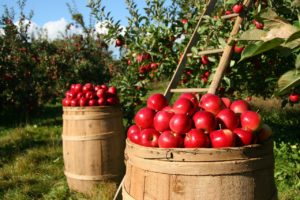 There are plenty of things you can do to celebrate the autumnal equinox. Here are some ideas:
- Plan a feast of locally harvested and in-season foods.
- Decorate your home with pumpkins, autumn leaves, and other reminders of the season.
- Make an offering to the gods — mead, harvested nuts, apples, and other in-season foods.
- Can, dehydrate, and freeze foods for winter.
- Go to a farm that allows you to pick your own apples or vegetables and do so.
Gods of the Autumnal Equinox
You should honor the gods of Autumn. You may wish to honor the following gods and goddesses:
- Thor and Sif — for rains and the grain harvest.
- Skadi and Ullr — for the fall and winter hunt, as well as snow sports.
- Freyr and Freyja — for the harvest bounty.
- Baldr and Hodr — for the balance of light and dark.
Let me know what you’re doing this equinox, if anything.
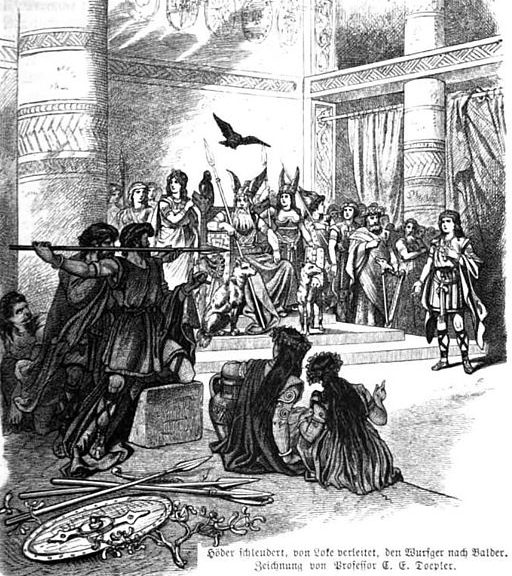
 One of the most iconic stories in Norse mythology is the death of Baldr. It is probably the best known among Heathens and often recited by the anti-Lokeans as a way to justify why the Rokkatru are wrong to even consider venerating Loki and his ilk. While I’m not Rokkatru (although I suppose someone can point to me being a follower of Skadi as being a Rokkatru), I do have a deeper analysis of why the story of Baldr’s death is more than face value.
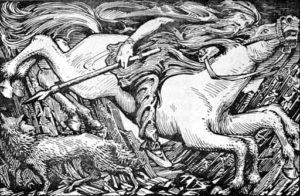 Baldr had nightmares of his death. Odin therefore went to Niflheim to consult a dead seeress to find out what was the cause of Baldr’s nightmares. The seeress told Odin that that Baldr would die by Hodr’s hand (Hodr is the brother of Baldr).
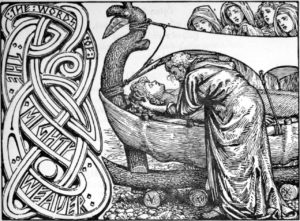 was not throwing things. Loki offered to guide Hodr’s hand so he could throw something. He put the mistletoe into Hodr’s hand. Hodr threw and the dart pierced Baldr’s heart. Baldr fell dead.
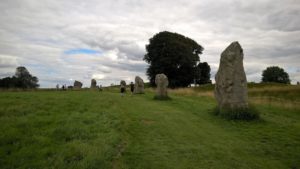 The story of Baldr is the story of the seasons and the natural cycle of life. Our northern ancestors revered the sun and its life-giving heat and warmth. We know the summer solstice was a holy time for northern pagans — especially those who built monuments to the sun during the neolithic age. Baldr is clearly associated with the midsummer sun — the sun at solstice. It is no surprise that his blind brother, Hodr (winter) slays him with the help of Loki (who is a chaos god) which brings about renewal (Ragnarok). Baldr is the renewal of life and all the beauty associated with it. Hodr is the old age and the impending death. Loki (chaos and entropy) brings these changes about.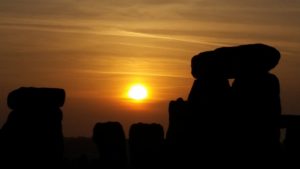
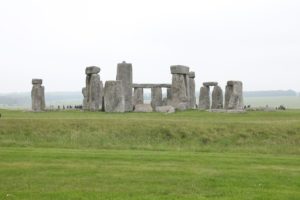 It’s little wonder why the mistletoe is a symbol of the winter solstice, since it is the symbol of Baldr’s death. But the winter solstice is also the symbol of the return of life. We know that the days will grow longer again after December 21st, just as we know the days will start to grow shorter after June 21st. So, this summer solstice, raise a horn or glass of mead to the god of rebirth and renewal. Because we know that Baldr may “die” with the oncoming winter, but he will be reborn once again. (And the Christians thought that they were the only ones with a god who dies and is reborn?)